
You are at a crucial crossroads for the future of your online business: choosing the technology platform on which you will build your digital empire. On the one hand, you have Shopify, the eCommerce giant that promises a fast, powerful, all-in-one solution. On the other, the idea of a custom website, a blank canvas where every pixel and every function is designed exclusively for you. The decision is not trivial and can determine your agility, scalability and budget. So, in the great battle of Shopify vs. custom web, What's the best option for your goals, your equipment and your wallet? In this comprehensive guide, we'll break down each key aspect for you to make an informed and strategic decision.
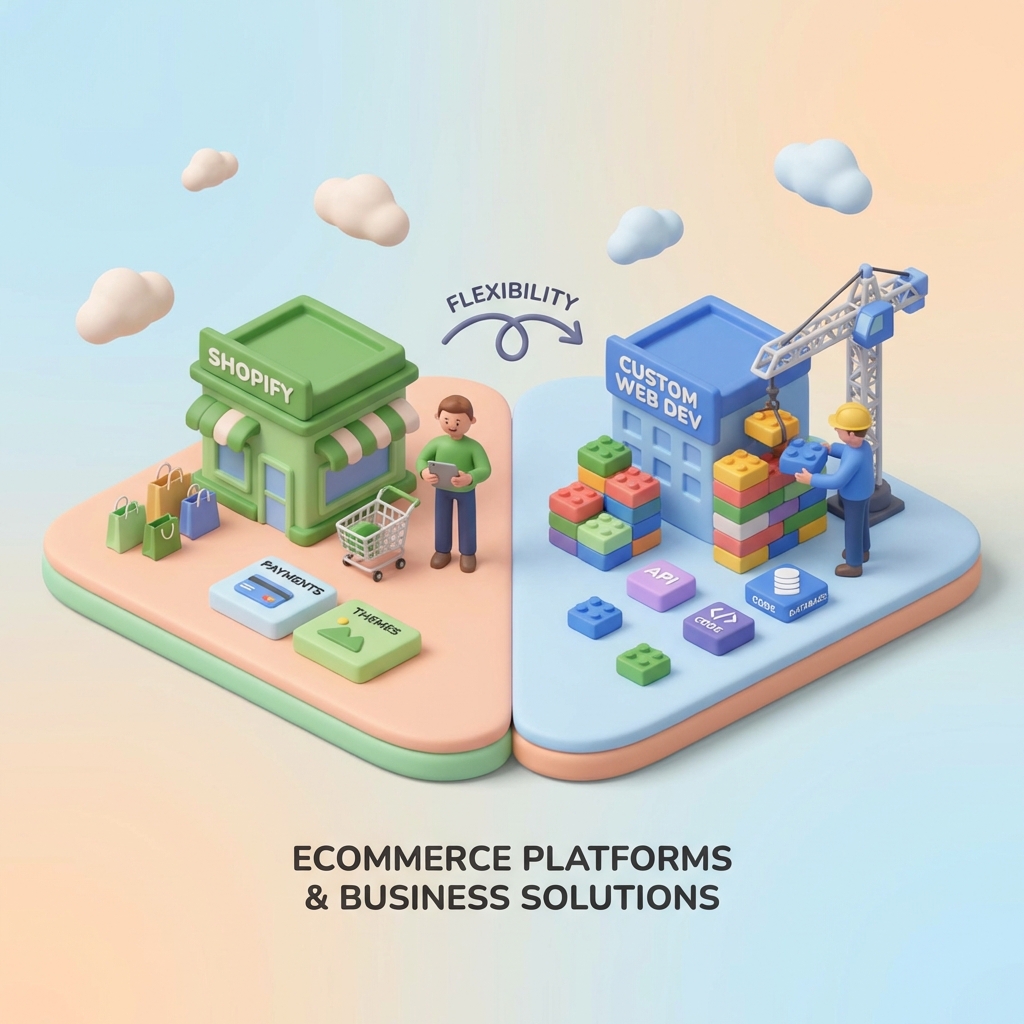
What is Shopify and what is a Custom Website? Understanding the Basics
Before diving into the comparison, it is essential to understand the nature of each option. They are not simply two different paths to the same destination; they represent completely different business philosophies.
Shopify: The All-in-One Ecosystem for eCommerce
Shopify is a platform type SaaS (Software as a Service). This means you pay a monthly or annual subscription fee to use their software. In return, Shopify takes care of most of the technical infrastructure for you:
- Web hosting: Your store is hosted on Shopify's servers, optimized for speed and security.
- Safety: It includes a free SSL certificate and is PCI compliant for secure payment processing.
- Software and updates: The platform updates automatically, without you having to intervene.
- Templates and customization: It offers a wide marketplace of themes (free and paid) to design your store, which you can customize without touching a line of code.
- App Store: Its greatest strength is a massive ecosystem of applications to add any functionality you can imagine, from email marketing to advanced inventory management.
In short, Shopify is designed to enable entrepreneurs and businesses to launch a robust and professional online store in the shortest possible time, even without in-depth technical knowledge.
Custom Web: Total Control Comes at a Price
A custom website is exactly what the name implies: a website built from scratch to meet your specific requirements. This involves hiring a team of developers and designers, or having one in-house. Technologies can vary enormously, from an open source CMS such as WordPress with WooCommerce o Magento, to a completely customized development with frameworks such as React, Vue.js or Laravel.
The main features of a customized website are:
- Absolute Control: Every aspect of design, user experience (UX) and functionality is under your control. There are no limitations imposed by a platform.
- Ownership of the Code: The source code belongs to you. You can modify it, migrate it or do whatever you want with it.
- Tailor-made integrations: You can create seamless and deep integrations with any other system your company uses (ERPs, CRMs, proprietary logistics software).
- Total Responsibility: You are responsible for everything: finding and paying for a web hosting provider, managing security, performing updates, and troubleshooting any technical issues.
A custom website is the option for companies that have unique needs that standard platforms cannot meet and that have the budget and resources to manage it.
Shopify vs. Custom Web: Detailed Comparison in 5 Key Points
Now that we understand the fundamental differences, let's take a face-to-face look at the most important factors to consider.
1. Initial Cost and Complexity: Predictable Budget or Heavy Investment?
This is often the deciding factor for most businesses.
With Shopify, The costs are transparent and predictable. Their model is based on subscription plans, such as the basic plan which is around 25-30€ per month, allowing you to get started with a minimal initial investment. As a Ranktracker review points out, you can have a functional store with unlimited products for a fixed monthly cost. This eliminates financial uncertainty and allows startups to allocate their capital to marketing and inventory. The setup process is quick and guided, without the need for a large team.
A customized web, The initial investment, on the other hand, is significantly higher. We are talking about thousands or even tens of thousands of euros, depending on the complexity. According to Ranktracker's research, this path requires «significantly more effort», including a full team and a long creative and development process. To this initial cost you must add recurring expenses for high-performance hosting, maintenance, software licenses and the salary of the technical team or an agency fee.
2. Scalability and Product Catalog: Are there Limits to your Growth?
What happens when your business takes off and your product portfolio multiplies? The ability to scale is vital.
Shopify is built for scale. One of its most outstanding advantages is that it allows you to publish a unlimited number of products in all their plans. Its infrastructure is prepared to support from small stores to giants with hundreds of thousands of referrals and massive traffic peaks (such as during Black Friday) without you having to worry about server capacity.
A customized web theoretically offers infinite scalability, but with an important caveat: you are responsible for building it and paying for it.. Your site's ability to handle a large catalog or traffic peaks will depend directly on the quality of the software architecture, database optimization and, above all, the hosting plan you sign up for. Scaling can involve complex and costly server migrations.
3. Dropshipping Facility: The Business Model of the Moment
Dropshipping allows you to sell products without managing physical inventory. The choice of platform is key to success in this model.
Here, Shopify is the undisputed leader. The platform is described as «ideal for dropshipping» thanks to its seamless integration with applications designed for dropshipping. Tools like DSers connect directly with suppliers like AliExpress, allowing you to import products, synchronize inventory and process orders with a few clicks. The entire ecosystem is optimized for this business model.
In a customized web (for example, with WooCommerce), dropshipping is possible, but almost always more complex. You will need to install and configure third-party plugins that may not be as polished or integrated as Shopify solutions. Managing real-time inventory and price synchronization can become a technical challenge, often requiring custom solutions that increase cost and complexity.
4. Domain, Hosting and Technical Management: »Hands Free» or Total Control?
Technical management is an invisible but fundamental task for the success of any online store.
Shopify offers a «hands-free» experience. The platform provides an all-in-one solution. Hosting is included, they give you a free subdomain to get started, and buying or connecting a custom domain is a simple process. Shopify takes care of security, patches, server updates, and performance. This frees you up to focus on what really matters: selling.
With a customized web, You assume the role of technical manager. You are responsible for selecting, contracting and configuring a web hosting provider. You must manage the purchase and installation of the domain and SSL certificates, apply security patches, update the base software and optimize server performance. This gives you full control over your environment, but it also requires time, technical expertise and a maintenance budget.
5. Integrated Commerce Ecosystem: Payments, POS, and Security
Selling online is much more than just having a pretty website. You need a robust system to process payments, handle in-person sales and protect against fraud.
The integrated ecosystem of Shopify is one of its biggest competitive advantages. It offers a set of native tools that a custom website would have to build from scratch. This includes:
- Shopify Payments: Its proprietary payment processor that, when activated, eliminates Shopify's transaction fees, simplifying fees.
- Shopify POS (Point of Sale): A complete system to unify your online and physical store sales. Inventory, customers and orders are synchronized in one place.
- Fraud Protection: Fraud analysis integrated into every order to help you identify risky transactions.
- Shopify Checkout: An ultra-optimized payment process, proven in millions of transactions, designed to maximize conversion.
Replicating this level of integration in a customized web is a massive and expensive project. You'd have to integrate third-party payment gateways like Stripe or PayPal, find a POS system that syncs with your custom database, hire outside fraud analysis services, and develop and optimize your own checkout process, which is notoriously difficult to do well.
Quick Comparison Chart: Shopify vs Custom Website
| Feature | Shopify | Custom Web |
|---|---|---|
| Initial Cost | Low (monthly subscription) | Very High (development) |
| Launch Time | Fast (days/weeks) | Slow (months) |
| Ease of Use | Very high (no code) | Low (requires technical equipment) |
| Customization | High (limited by the platform) | Total and Absolute |
| Technical Maintenance | Included (managed by Shopify) | Required (managed by you) |
| Integrated Ecosystem | Native and complete (Payments, POS) | Must be built with integrations |
| Technical Support | 24/7 included | Depends on your team or agency |
When to choose Shopify?
Shopify is the winning choice if you identify with any of these profiles:
- Startups and SMEs: If your budget is limited and you need to maximize your return on investment.
- Rapid Launch: If you want to validate your business idea in the market as soon as possible.
- No Technical Equipment: If you are not a programmer and do not want to deal with server management and security.
- Dropshipping business: If your business model is based on selling without inventory, its ecosystem is unbeatable.
- Brands that Prioritize Sales: If your focus is 100% on marketing and sales, and not on the underlying technology.
When to opt for a Custom Web?
A customized website is the right choice in more specific scenarios:
- Unique Functionality: If your business model requires features that simply don't exist in Shopify's App Store (e.g. a hyper-complex product configurator).
- Legacy integrations: If you need a deep, bi-directional integration with your company's proprietary ERP or CRM.
- Branding and UX without Compromises: If your brand demands a unique 100% user experience and design, without the constraints of a template.
- Large Resource Companies: If you have an in-house development team and a comfortable budget for creation and ongoing maintenance.
Conclusion: There is no Winner, only the Right Choice for You.
At the end of the day, the comparative Shopify vs. custom web has no universal winner. The right choice depends entirely on your circumstances, resources and ambitions.
Shopify is an incredibly powerful, democratized e-commerce solution optimized for speed and ease of use. It removes technical barriers so anyone can start selling.
A customized web is a precision tool, a digital couture suit. It offers unlimited power and flexibility, but requires commensurate investment and technical expertise.
Evaluate your budget, your team, your functionality needs and your timeline. The final decision in the Shopify vs. custom website battle is not dictated by the technology, but by your business vision. Choose the tool that works best for you to build it.
Do you need help with this?
We build and optimize WooCommerce stores that are ready to scale without sacrificing speed. Discover our Scalable WooCommerce development service.


