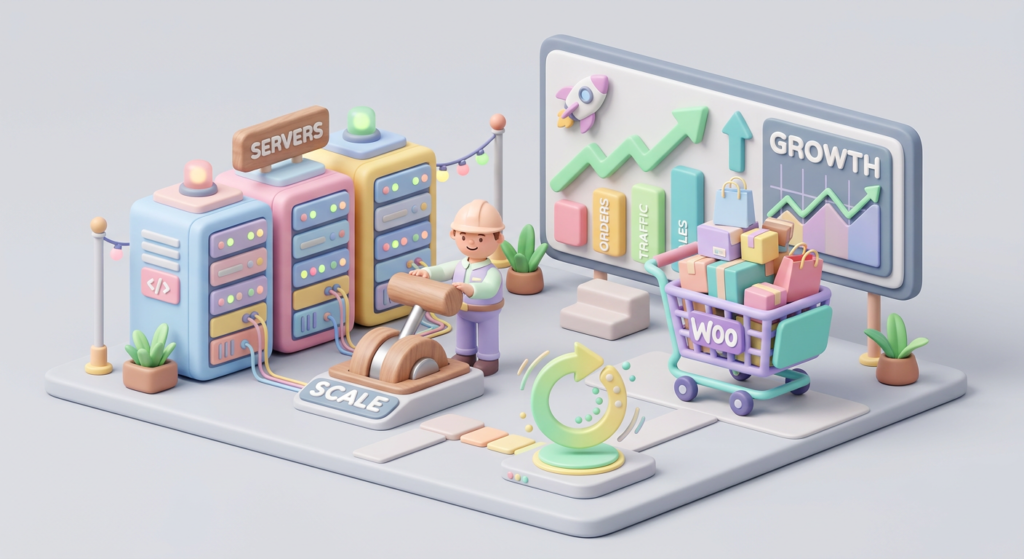
You have your website online. Maybe it cost you months of work, thousands of euros in design, hours of meetings to choose colors, fonts and pictures. It is beautiful. It's published. And yet, the phone doesn't ring. The contact form is gathering digital dust. Your website does not generate customers and you don't understand why.
I've been developing custom WordPress projects for over a decade and I've lost count of how many times a client has told me exactly that: «Marcos, my page is there but no one is reaching me». After auditing hundreds of sites, I can assure you that the problem is almost never just one. There are several technical and strategic failures that silently accumulate and turn your website into an invisible showcase. Today we are going to uncover them all.
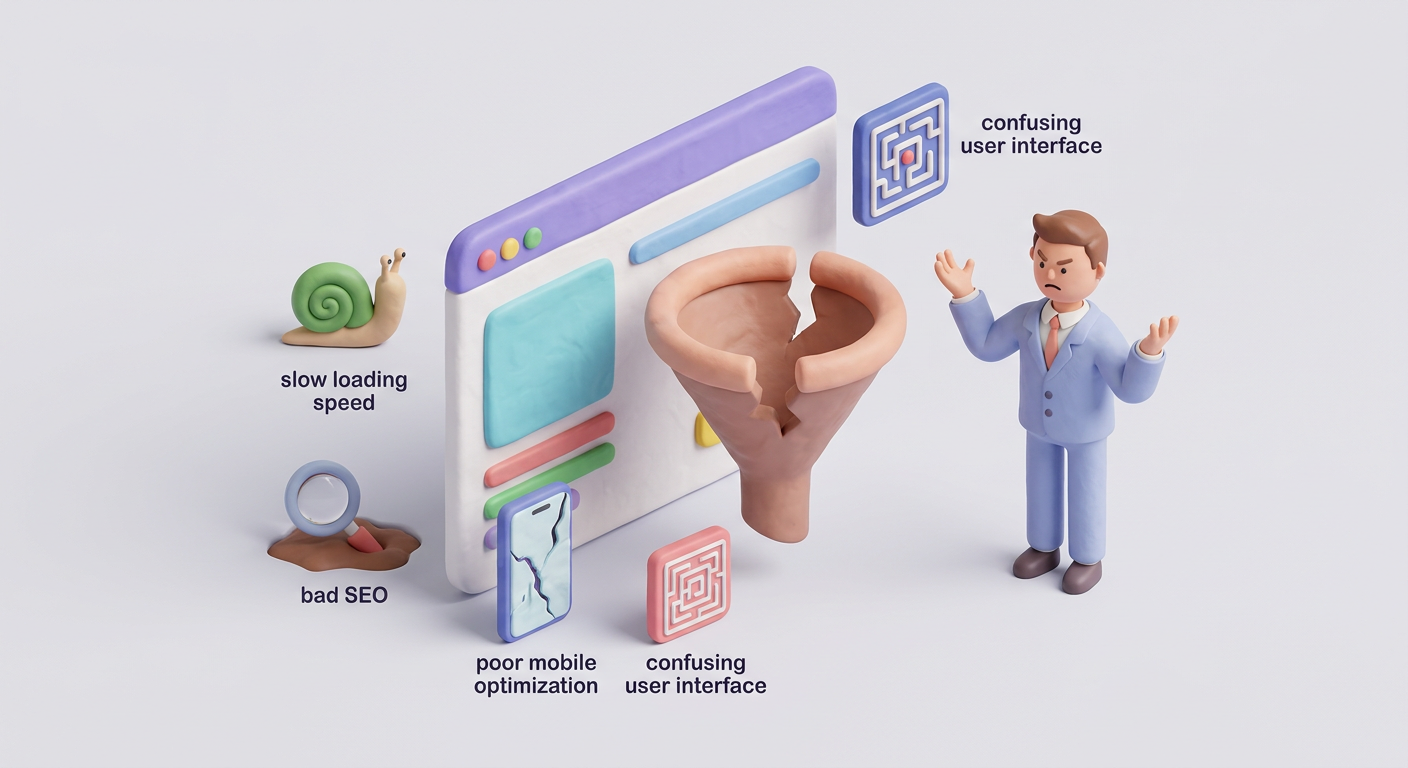
Painful fact: According to Google data, 53% of mobile users abandon a website that takes more than 3 seconds to load. If you add to that the fact that your website does not appear in search results and does not guide the user to any specific action, the result is a digital investment that works against you.
Why am I not getting any sales on my website?
This is the question I am asked most often. And the answer is never simple, but it does have a clear pattern: a website that does not sell is a website that is not built to sell.. It seems obvious, but it is not so obvious when you analyze it in detail.
Most websites are designed from the perspective of what the business wants to tell, not what the customer needs to find. There is a huge difference between the two. Your website can talk for paragraphs about your story, your values and your team, but if the user doesn't understand in 5 seconds what problem you solve and why he should choose you, he leaves. Without saying goodbye. Without leaving a trace.
The 7 reasons that I am going to break down are the ones that I find recurrently in each audit. And most importantly, they all have a technical solution.
1. Your website does not appear in Google (poor technical SEO)
Yes my website does not appear in Google is the phrase in your head, this is probably your main problem. It's no use having the best website in the world if nobody can find it.
In my technical audits, these are the SEO errors I detect most frequently in WordPress:
- Indexing blocked: a checkbox checked in Settings > Reading > «Discourage search engines from indexing this site» that someone checked during development and never unchecked. I see it more than you might imagine.
- No XML sitemap: Google needs a sitemap to crawl your pages efficiently. Without it, crawling is biased and unpredictable.
- Poor URL structure: URLs with cryptic parameters type
?p=123instead of descriptive slugs like/servicios-diseno-web/. - Duplicate or missing meta titles and descriptions: each page needs a unique title and description that includes your target keywords.
- No structured data: schema markup helps Google understand what your business is, where it is and what it offers. Without it, you lose opportunities to appear in rich results.
Quick check: write site:yourdomain.com in Google. If few or no pages appear, you have a serious indexing problem. If they appear but with generic titles such as «Page 1 - My company», your on-page SEO needs a complete overhaul.
2. Unacceptable loading speed
A web with no traffic many times it is a slow website that Google has decided not to rank. Core Web Vitals (LCP, INP, CLS) are confirmed ranking factors, and a website that takes 6 or 7 seconds to load is being actively penalized in search results.
The usual technical causes I find in WordPress:
- Cheap shared hosting with server response times (TTFB) higher than 1 second.
- 2-4 MB images uploaded without compressing or converting to WebP/AVIF.
- Page builders that generate tons of unnecessary CSS and inline JavaScript.
- 30, 40 or 50 active plugins loading scripts on all pages, including those where they are not used.
- Total absence of cache system and CDN.
Direct impact: I've measured sites where speed optimization tripled conversions without changing a word of content. Same traffic, same pages, but loading in 1.8 seconds instead of 7. Speed is not a secondary technical issue: it's money.
No clear value proposition
When a user lands on your website, he scans the page in a few seconds looking for answers to very specific questions: What does this company do? Does it solve my problem? Why should I choose it? If your website responds with phrases like «integral solutions», «quality and commitment» or «experience and professionalism», you have lost.
These phrases say nothing. They do not differentiate. They don't position. They are the digital equivalent of a blank billboard. An effective value proposition is concrete, specific and relevant to your ideal customer:
- Wrong: «We offer customized digital solutions for your business.».
- Good: «We design online stores on WooCommerce that load in less than 2 seconds and increase your conversion rate a 40%.».
The difference is that the second sentence tells the user exactly what you do, for whom and what result they can expect. The first could be from any company on the planet.
4. Confusing web structure that does not guide the user
Menus with 12 options. Submenus within submenus. Pages that lead nowhere. Mixed services with no clear hierarchy. If the user has to think to navigate your site, you've already lost him.
The structure of a converting website follows a basic principle: each page must have a single objective and lead to a single action. This translates into:
- Main menu with a maximum of 5-7 clear options.
- Content hierarchy that prioritizes the most profitable services.
- Breadcrumbs so that the user always knows where he/she is.
- Strategic internal links that guide the user's path to conversion.
- Individual service pages with their own CTA, not a generic listing where everything is mixed together.
Rule I apply: In every page I develop, I ask myself «what do I want the user to do after reading this? If there is no clear answer, the page is not finished. Each section should gently nudge the visitor to the next step.
5. Absence of effective CTAs (calls to action).
It is surprising how many websites do not have a single action button visible above the fold. The user arrives, reads (if the site loads), and finds no clear indication of what to do next. There is no «Request a quote», no «Schedule a call», no «Download the guide». Nothing.
Calls to action must meet three technical requirements:
- Visibility: sufficient contrast with the background, minimum size of 44×44 pixels for mobile (Google accessibility guideline), and positioning above the fold.
- Clarity: the user must know exactly what is going to happen when he clicks. «Submit» is not a good CTA. «Request free quote» is.
- Strategic repetition: a CTA at the top, one at the middle of the page and one at the bottom. The user can decide at any time, and the button should be there when they do.
How to attract customers to my website?
This is the other side of the coin. It's not enough to fix your website's internal problems; you also need to get the right traffic to it. And this is where reasons 6 and 7 come into play.
6. No content strategy or blog
A static website with 5 pages (home, services, about us, portfolio, contact) has a very low positioning ceiling. Google rewards fresh, relevant content that answers the questions your potential customers type into the search engine.
A well-planned technical blog does several things for you simultaneously:
- Position your website for hundreds of long tail keywords your customers use when looking for solutions.
- Demonstrate authority and knowledge in your sector, generating trust before the first contact.
- Create organic entry points that feed your conversion funnel without recurring advertising costs.
- Improve your internal link structure, strengthening the SEO of your main service pages.
Common mistake: publish 3 articles the first month and then abandon the blog for a year. Google values consistency. One well-crafted article every two weeks beats 20 mediocre articles published all at once and then nothing.
7. Web not adapted to mobile (or only half adapted)
In Spain, more than 60% of web traffic is mobile. Google indexes the mobile-first version of your website first (mobile-first indexing). If your site does not work well on mobile, you are invisible to most of your potential customers.
And when I say «it doesn't work well on mobile» I don't just mean that it's responsive. I am referring to specific technical problems:
- Buttons too small or too close together causing accidental touches.
- Text that requires zoom to read.
- Forms with fields that do not adapt to the width of the screen.
- Intrusive pop-ups that cover the entire screen and do not have an accessible close button.
- Hamburger menus that do not work properly or obscure critical navigation.
- Elements that overlap or change position when loading (high CLS).
Quick test: open your website from mobile and try to complete the main action (submit a form, call, buy). If you take more than 3 taps or feel frustrated, your customers feel exactly the same. And they go to the competition.
What to do when no customers arrive?
First of all, don't panic and don't make reactive decisions. Redesigning the entire website from scratch is rarely the solution. I have seen companies spend €8,000 on a redesign that repeats exactly the same structural errors with a different aesthetic.
The correct approach is as follows:
- Complete technical audit: analyze speed, technical SEO, indexing, Core Web Vitals, structure, mobile usability and analytics configuration.
- Identify leakage points: with real data from Google Analytics and Search Console, determine where users enter, where they leave and why they don't convert.
- Prioritize by impact: not everything can be fixed at once. The corrections that have the greatest impact on the conversion with the least technical effort are prioritized.
- Implement and measure: every change must be measurable. If you can't measure the impact, you can't improve.
What can I do if there are no customers?
If your web does not generate sales and you feel like you've tried everything, what you probably haven't tried is looking at your website with technical and not emotional eyes. It doesn't matter if you love the design or if your brother-in-law says «it's really cool». What matters is the data: Does it load fast? Does it show up in Google? Does the user understand what you do in 5 seconds? Is there a clear path to conversion?
In my experience, most websites that «don't generate customers» need between 3 and 5 specific technical corrections to start working. It is not magic. It's web engineering applied with criteria.
Quick self-diagnosis checklist:
- Does your website load in less than 3 seconds on mobile? Check it out at PageSpeed Insights.
- Do you appear in Google when searching for
site:yourdomain.com? - Do you have Google Search Console configured and without critical errors?
- Does each page have a unique title and description with your keyword?
- Is there at least one CTA visible without scrolling?
- Does your website work correctly on mobile?
- Do you have any content published in the last 3 months?
If you answered «no» to 3 or more questions, you have your diagnosis.
Conclusion: your website should be your best salesperson, not a digital brochure.
A website that does not generate customers is not a problem of bad luck or a difficult market. It is a technical problem with technical solutions. Each of the 7 reasons I've broken down has a specific fix that can be implemented, measured and optimized.
The most expensive mistake is not having a website with problems. The most expensive mistake is to let months go by knowing that something is wrong and not acting. Every day that your website does not convert is a day that your competitors capture customers that should have been yours.
If you want to know exactly what is wrong with your website and what is needed to turn it into a tool that really generates customers, I can analyze it in depth. No commitment, no smoke, just data and a clear action plan.
Do you need help with this?
We design websites that are built to turn visitors into customers—not just to look good. Discover our strategic web design service.