
The universe of web design and development tools is evolving at breakneck speed. What was revolutionary yesterday is the standard today. In this whirlwind of innovation, one question resonates strongly among designers, marketers and entrepreneurs: is Framer worth it in 2025? If you're considering this platform for your next project, you've come to the right place. No longer just a prototyping tool, Framer has transformed into a full-fledged contender for website creation. In this in-depth analysis, we'll break down its advantages, disadvantages, and its position in today's competitive landscape to give you a clear and definitive answer.
1. The Evolution of Framer: From Prototyping Tool to Comprehensive Web Platform
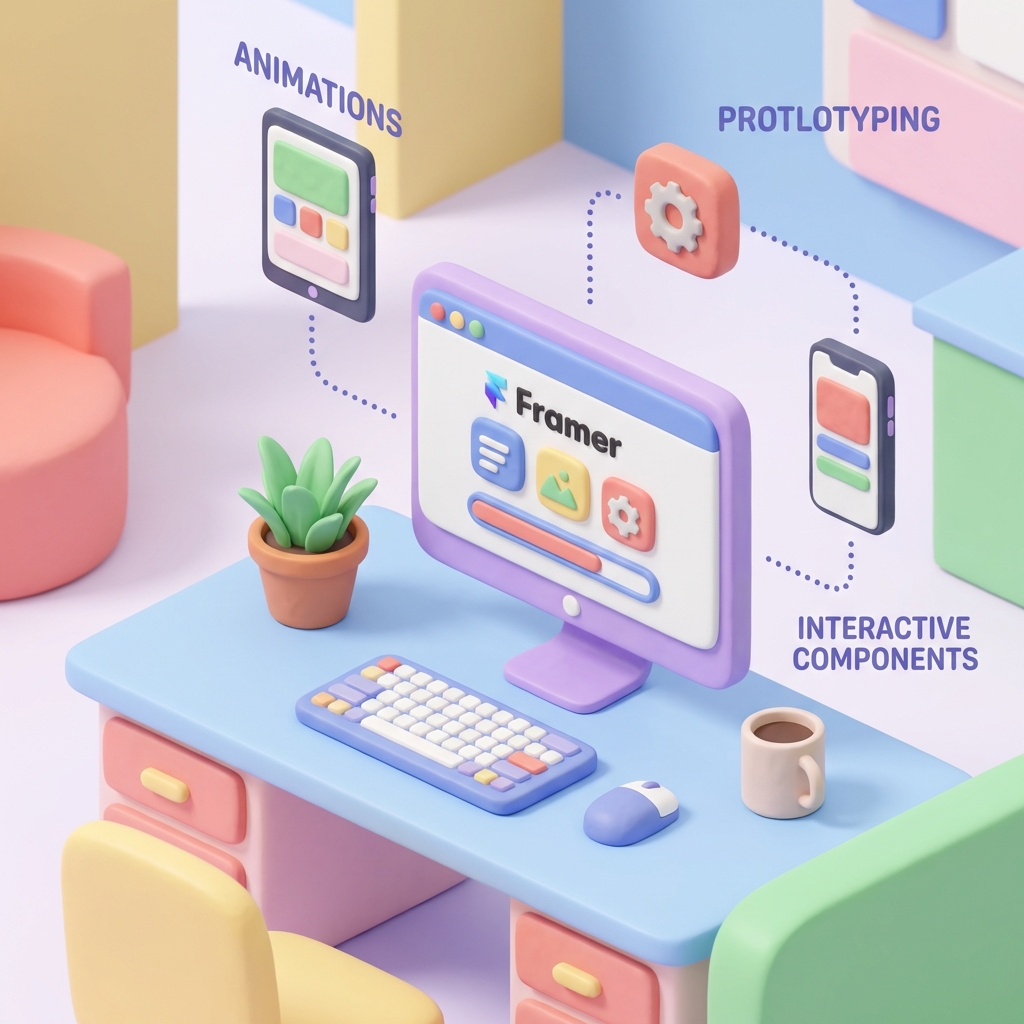
To understand the value of Framer today, it is crucial to know its journey. Originally, Framer (and its predecessor, Framer X) was a haven for UI/UX designers who wanted to create ultra-high fidelity prototypes, so realistic that they were often indistinguishable from a real application. Its strength lay in its ability to integrate React code, allowing complex interactions that other tools could only dream of.
However, the Framer team identified a fundamental gap in the workflow: the painful transition from design to production. A perfect prototype at Framer still needed to be rebuilt from scratch by developers. That's when the big twist happened.
Framer decided to become the tool that would close that cycle, evolving into an all-in-one web publishing platform. It got rid of the complexity of end-user code and adopted a visual interface that is incredibly familiar to anyone who has used Figma. Today, in 2025, Framer is not a prototyping tool that exports code; it is a design tool that publishes real, functional and high-performance websites directly from the canvas.
2. Key Functionality Analysis in 2025: What Makes Framer Special?
The 2025 Framer rests on three pillars that differentiate it from the competition. Let's take a look at each of them.
Artificial Intelligence at the Service of Design
Framer has intelligently integrated AI into the entire workflow. It's not about replacing the designer, but empowering him or her. Its AI capabilities include:
- Page Generation: You can write a detailed prompt describing the site you need (e.g. «a landing page for a meditation app with pastel tones and a minimalist design») and the AI will generate a fully functional and stylish base in seconds.
- Copywriting and Translation: Stuck with text? AI can generate copy for entire sections, come up with headlines or even translate your content into multiple languages.
- Location and Styles: AI can also adapt styles and content for different regions, a massive boost for global projects.
This artificial intelligence layer dramatically speeds up the initial phase of any project, allowing teams to go from idea to first draft in minutes, not days.
Interactive Components and Code-Free Animations
This is where Framer's prototyping DNA shines brightest. Creating complex animations that respond to scroll, cursor movement or on-screen appearance is amazingly simple. Predefined «Effects» (Appear, Hover, Scroll, etc.) are applied with a couple of clicks.
In addition, its Components with Variants is a game changer. You can create a button and then define its different states (default, hover, pressed) as variants. Framer takes care of animating the transition between them automatically. This allows you to build consistent, interactive design systems without writing a single line of CSS or JavaScript.
The Design to Production Flow: Every Designer's Dream
Framer's mantra is «design and publish from the same place». This eliminates the friction and loss of fidelity of the handoff process. What you design on the canvas is exactly what you will see on the published site.
A key part of this flow is the popular Figma to Framer« plugin». It allows teams who already have their layout systems in Figma to import their creations into Framer with impressive fidelity. The plugin converts Figma auto layouts into Framer stacks, preserving responsiveness and structure. From there, all that remains is to add the interactions and publish.
3. Updated Competitive Comparison: Framer vs. Webflow, WordPress and the New «AI-first» Alternatives»
No tool exists in a vacuum. To determine whether Framer is worth Framer in 2025, we must compare it to its main rivals.
Framer vs. Webflow: The Battle of the Visual Builders
Webflow has long been the king of visual web builders for professionals. The choice between the two depends largely on your profile and priorities.
- Learning Curve: Framer wins by a landslide. Its interface, similar to Figma, is much more intuitive for designers. Webflow, based on the traditional CSS box model, has a considerably steeper learning curve.
- Animations and Interactions: Framer is superior in ease and power for creating fluid and complex animations without code.
- CMS and E-commerce: Webflow continues to have a more robust and mature CMS, ideal for sites with large volumes of dynamic content and complex data structures. Its E-commerce solution is also more developed.
- Speed of Creation: Thanks to AI and its interface, Framer allows you to build and launch sites faster.
Framer vs. WordPress: Modernity vs. Market Dominance?
Compare Framer with WordPress is like comparing a modern electric car to a customizable pickup truck. Both get you to your destination, but the experience and purpose are different.
- Ease of use and maintenance: Framer is an all-in-one solution (design, CMS, hosting, CDN). You don't have to worry about plugins, security updates or compatibilities. WordPress requires active management of hosting, themes, plugins and security.
- Performance: Framer sites are incredibly fast out of the box thanks to their optimized infrastructure. Achieving similar speed on WordPress often requires caching plugins, image optimization and good hosting, which adds complexity and cost.
- Flexibility and Ecosystem: WordPress is unbeatable in flexibility. With thousands of plugins, you can build almost anything: from a massive forum to a social network or an online store with thousands of products. Framer is more limited for very specific backend functionality.
Framer vs. AI-first tools (Durable, 10Web, etc.)
The new «AI-first» tools promise to create a website in 30 seconds. And they deliver. However, their weakness is customization. Once the site is generated, editing options are very limited. Framer, on the other hand, uses AI as a starting point, but it gives you total and granular control over each pixel. It is the perfect combination of AI speed and professional design control.
4. Performance, SEO and Pricing Structure: The Real Impact on your Project
A nice design is useless if the site is slow or invisible to Google. How does Framer perform in these critical areas?
Web Performance and Speed
This is one of Framer's biggest selling points. By default, all sites published on Framer are optimized for elite performance. This includes:
- Hosting on a global network of servers (CDN).
- Automatic image optimization (WebP format, lazy loading).
- CSS and JS code minification.
- Clean and semantic code.
The result is consistently high scores on tools such as Google PageSpeed Insights, a key factor for SEO and user experience.
SEO Capabilities: Can You Rank a Site Made in Framer?
Absolutely yes. Framer provides all the essential tools you need for a solid SEO strategy:
- Full control over titles and meta descriptions (at page and CMS level).
- Customizable and clean URLs.
- Automatic generation of sitemaps.
- Alt tags for images.
- Correct use of semantic tags (H1, H2, P, etc.).
- 301 redirect manager.
Analysis of the Pricing Structure in 2025
Framer's pricing structure is competitive and transparent. Plans typically include hosting, CDN and SSL certificate, which simplifies costs. Updated details can be found on their official pricing page, but in general they are divided into:
- Free: Ideal for testing the tool and for small personal projects (with Framer branding).
- Mini: For simple sites with a custom domain, such as a link-in-bio page.
- Basic: Perfect for most personal sites, portfolios and marketing sites. Includes CMS.
- Pro: For larger sites with higher traffic and CMS needs.
When comparing prices, remember to add the hidden costs of other platforms, such as hosting, premium themes and paid plugins that are already included in Framer.
5. The Ideal User Profile for Framer in 2025 and its Vision for the Future
After this analysis, we can clearly define who this tool is for and who it is not for.
Who is Framer the Best Choice for?
- UI/UX designers: It's the dream tool. It allows them to build exactly what they design, with total creative freedom and without relying on developers.
- Marketers and Growth Teams: Ideal for launching landing pages and marketing campaigns at high speed, without sacrificing design quality.
- Startups and Small Businesses: It allows you to have a professional and high performance web presence with a much lower investment of time and resources.
- Freelancers and Design Agencies: A secret weapon to deliver impressive web projects faster and more cost-effectively.
Who is Framer NOT for?
- Projects with complex backend: If you need a custom database, advanced server logic or deep integrations with internal systems, Framer is not the choice.
- E-commerce on a large scale: Although solutions like Gumroad or Lemon Squeezy can be integrated, for an online store with thousands of products and complex logistics, platforms like Shopify remain the standard.
- Developers who want full control of the code and the server: If your priority is absolute control over the hosting environment and source code, a self-hosted solution is more suitable.
Conclusion: So, is it worth Framer in 2025?
The short answer is a resounding yes, for the right user and the right project.
Framer in 2025 has established itself as one of the world's best platforms for creating design, marketing and visual storytelling oriented websites. Its combination of a top-notch design interface, powerful codeless animation capabilities, exceptional performance and smart AI integration make it an extremely attractive option.
It's not trying to replace WordPress or Shopify in their respective niches, but has created its own: the place where design is uncompromised and speed of execution is key. If you're a designer, marketer, or a company that values a flawless, high-performing web presence without the complexity of traditional development, Framer is not only worth your time, but could become your tool of choice.
The best way to be convinced is to try it. Create a free account, If Framer is the missing piece in your workflow for 2025 and beyond, import a Figma design or play with his AI, and find out if Framer is the missing piece in your workflow for 2025 and beyond.
Do you need help with this?
We design websites that are built to turn visitors into customers—not just to look good. Discover our strategic web design service.


