
You are about to launch your online store, a decision that can transform your business. But before you start selling, you face a crucial choice that will define the future of your project: which eCommerce platform to choose? Two of the most powerful names on the market, WooCommerce and Prestashop, are the preferred options for millions of entrepreneurs. The question is inevitable: in the battle WooCommerce vs Prestashop, which one is the winner for you? In this definitive guide, we'll break down each aspect, advantage and disadvantage so you can make the most informed and strategic decision for your success.
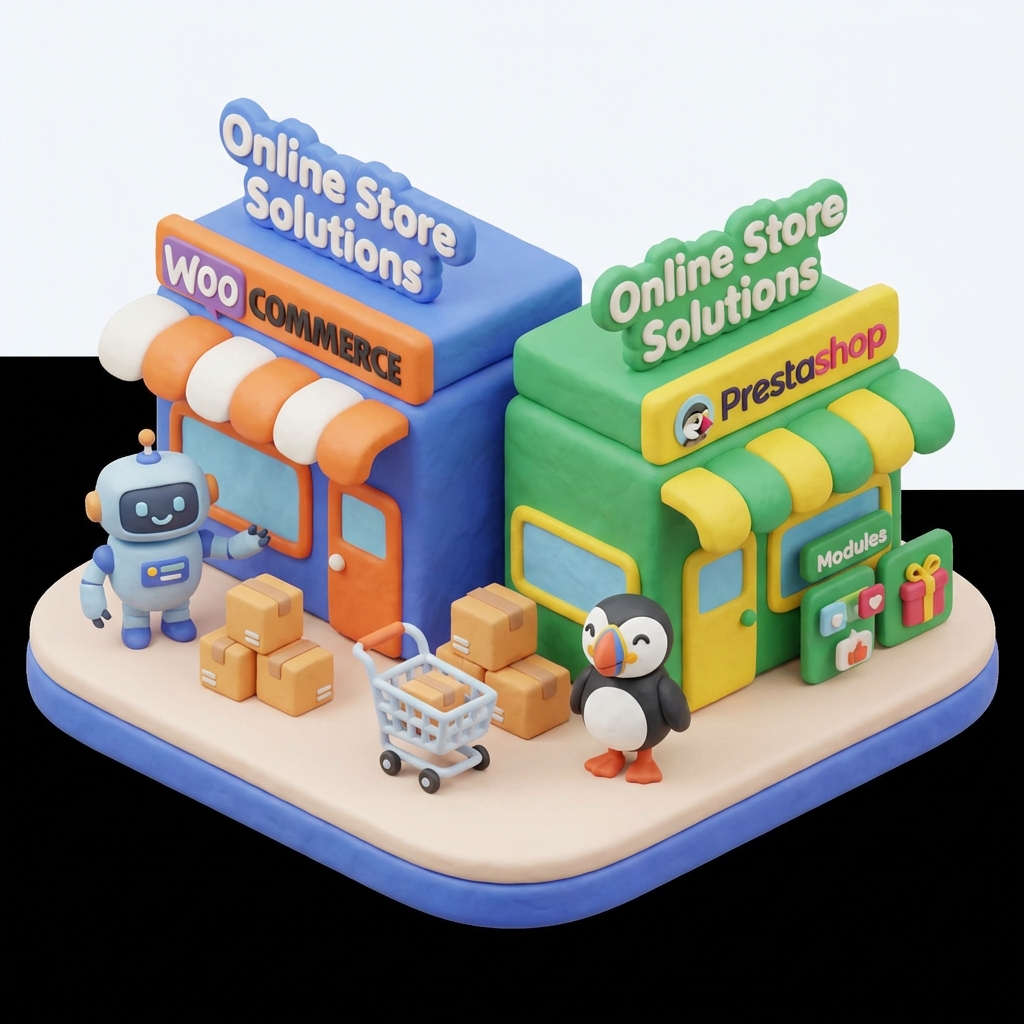
The Fundamental Difference: Plugin vs. Dedicated Platform
To understand this comparison, we must first clarify the nature of each solution. They are not the same, and this difference is the starting point for almost all their advantages and disadvantages.
WooCommerce is not a standalone platform. It is an open source plugin that installs on top of WordPress, the world's most popular content management system (CMS). This makes it a «hybrid system» that merges an elite blog and content management system with powerful online store functionality. If you already know WordPress, the learning curve will be much smoother.
On the other hand, Prestashop is a open source e-commerce platform designed exclusively for building online stores. Everything at its core, from its administration panel to its functionalities, is designed for sales. As detailed by industry experts, this distinction is key, because WooCommerce transforms a content site into a store, while Prestashop is a store from its conception..
Initial reflection: Does your business strategy rely heavily on content marketing, blogging and SEO? WooCommerce might have a head start. Is your approach 100% retail, with a complex catalog and no strong initial emphasis on content? Prestashop might seem more straightforward.
Comparative Analysis: WooCommerce vs Prestashop Head to Head
Now that we understand their structural difference, let's put them under the microscope in the areas that matter most to an online store owner.
1. Ease of Use and Learning Curve
For a beginner, ease of use is a decisive factor.
- WooCommerce: If you've ever used WordPress, you'll feel right at home. Installation is a matter of a couple of clicks from the plugin repository, and a setup wizard guides you through the initial steps (creating store pages, setting up payments, taxes, etc.). Daily product and order management is intuitively integrated into the WordPress dashboard.
- Prestashop: Its administration panel is very well organized and focused 100% on eCommerce. You will find clear sections for catalog, orders, customers and statistics. However, for someone without technical experience, it can be a bit more intimidating at first due to the large number of options and submenus. The initial installation also requires a bit more technical knowledge than the famous WordPress «5 minute installer».
Verdict: WooCommerce tends to be more beginner-friendly, especially for those who are already familiar with WordPress.
Content Management and SEO: The Strength of WooCommerce
This is where the fundamental difference becomes most apparent. Content marketing is vital for attracting organic traffic and building a brand.
Thanks to its native integration with WordPress, WooCommerce is described as a platform «unrivaled» in content management and structuring. You can create a powerful blog, complex landing pages, shopping guides, and use top SEO plugins like Yoast SEO or Rank Math to optimize every corner of your website with total flexibility.
Prestashop, on the other hand, includes a CMS section for creating content pages and a blog, but its capabilities are considerably simpler. As the reviews point out, its options are «very very limited» in comparison. Although they can be improved with paid modules, it does not reach the native power of the WordPress + WooCommerce duo.
Verdict: If blogging and content SEO are pillars of your marketing strategy, WooCommerce has an overwhelming advantage.
3. Flexibility and Customization (Themes and Modules/Plugins)
Both platforms are highly customizable, but their ecosystem is different.
- WooCommerce: You benefit from the gigantic WordPress ecosystem. There are thousands of free and paid themes (on sites such as ThemeForest) and over 50,000 plugins in the official WordPress repository. This gives you almost unlimited freedom to add any functionality you can imagine, from booking systems to memberships.
- Prestashop: It also has an official market, PrestaShop Addons, with thousands of themes and modules. However, the ecosystem is smaller and, in general, paid modules tend to be more expensive than their WooCommerce counterparts. The quality tends to be high, as they are designed specifically for the platform.
Verdict: Technical tie in capacity, but WooCommerce wins in volume and cost of extensions, offering a wider and often more affordable range of options.
4. Native Functionalities (Out-of-the-Box)
What do you get just by installing the platform, without adding anything extra?
Prestashop is often perceived as more complete «out of the box».». It comes with advanced catalog management tools, detailed statistical reporting, carrier management, PDF invoicing, and multi-store functionality natively. These features are robust and designed for pure e-commerce right out of the box.
WooCommerce provides all the essential functionality for selling: product management, shopping carts, payments, etc. However, for many advanced features that Prestashop includes as standard (such as advanced billing or multi-store management), you will need to install additional plugins, some of which may be paid.
Verdict: Prestashop offers a more robust and complete set of eCommerce tools natively.
5. Real Costs: Which is Cheaper?
Although both platforms are open source and «free», operating an online store always has costs associated with it.
- Software: Both are free to download and use.
- Hosting: Required for both. Prices are similar, although good hosting optimized for WooCommerce may be slightly more affordable due to the popularity of WordPress.
- Domain: Mandatory for both. The cost is the same.
- Theme/Design: Both have free and paid options. WooCommerce premium themes tend to have a wider and more competitive price range.
- Plugins/Modules: Here's the big difference. WooCommerce has a massive offer of free plugins. For Prestashop, it is more common to have to resort to paid modules for specific functionalities, and their average cost is usually higher.
- Development: Finding WordPress/WooCommerce developers is generally easier and cheaper than finding Prestashop experts, due to the immense popularity of the platform.
Beware of hidden costs! A functionality that in Prestashop requires an 80€ paid module, could have a free alternative or a 30€ plugin in WooCommerce. Plan the features you will need and budget for their extensions before deciding.
Verdict: In the long run, WooCommerce tends to be the cheaper option due to the greater availability of free and affordable plugins, and the lower cost of developers.
6. Technical Support and Community
Being open source platforms, this is a sore point for both.
A crucial factor to understand is that, with both platforms, «you do not have access to dedicated support» and free of charge.. There is no phone number or live chat to call if your store goes down. Support comes from other avenues.
- WooCommerce: It relies on the gigantic WordPress community. You'll find solutions to almost any problem in forums, blogs, Facebook groups and YouTube tutorials. The official documents is extensive, and premium plugin developers often offer excellent support for their products.
- Prestashop: It also has an active community and official forums. However, its size is smaller than WordPress. Prestashop offers official support plans, but they are paid and can be expensive for small businesses.
Verdict: WooCommerce wins because of the size and activity of its community, which makes it easy to find free or low-cost help.
History at a Glance: The Consolidated vs. the Explosive
A platform's track record also gives us clues about its reliability and future. Prestashop is the oldest platform, launched in 2007, which makes it a «consolidated» option with many years of development and refinement behind it. On the other hand, WooCommerce, launched in 2011, is more recent but has arrived «hitting hard», taking advantage of the WordPress base to experience explosive growth and dominate the market in terms of usage share.
Advantages and Disadvantages: The Final Summary
Advantages and Disadvantages of WooCommerce
- ✅ Advantages:
- Extreme Flexibility: Almost unlimited customization with thousands of plugins and themes.
- Best for SEO and Content: The integration with WordPress is unbeatable.
- Smooth Learning Curve: Very easy to use if you already know WordPress.
- Lower costs: Ecosystem with more free and affordable options.
- Huge Community: It is easy to find help and developers.
- ❌ Disadvantages:
- Dependency on Plugins: Requires extensions for advanced functionality.
- It can be heavy: A poor choice of plugins or theme can slow down the site.
- Safety: Because it is so popular, it is a frequent target of attacks (requires good security practices).
Advantages and Disadvantages of Prestashop
- ✅ Advantages:
- Robust Native Functionalities: Very complete from the factory (statistics, multi-store).
- Focused 100% on eCommerce: Everything is designed for sale.
- Solid Performance: Generally very efficient in managing large catalogs.
- Safety and Stability: As a more closed system, it is perceived as very stable.
- ❌ Disadvantages:
- Steeper Learning Curve: It can be complex for beginners.
- CMS Limited: Weak in content marketing and SEO in comparison.
- Higher Costs: Modules and themes tend to be more expensive.
- Smaller Community: Fewer free resources and harder-to-find developers.
The Final Tip: There Is No Winner, Just the Right Choice for YOU
After this exhaustive analysis, it is clear that there is no universal winner in the contest. WooCommerce vs Prestashop. The best platform is the one that aligns with your needs, skills and business strategy.
The most important recommendation: As experts advise, it is essential to «tinkering with both solutions before making a final decision. Install a trial version on a subdomain, upload some products, explore the admin panel and simulate day-to-day management. This hands-on experience will give you a clarity that no article can fully offer.
In summary:
- Choose WooCommerce if: Your content marketing strategy is key, you already use or like WordPress, you are looking for maximum flexibility and want to keep costs low. It's ideal for startups, monetizing blogs, and stores with a strong branding component.
- Choose Prestashop if: Your project is a pure eCommerce project with a large or complex catalog, you need advanced features as standard (such as multi-store), and you value a stable and dedicated retail environment above all else. It is a solid choice for established stores and 100% retail projects.
Do you need help with this?
We build and optimize WooCommerce stores that are ready to scale without sacrificing speed. Discover our Scalable WooCommerce development service.


