
In the world of web development, one of the most common crossroads for both entrepreneurs and programmers is the choice of the base technology for a new project. The million-dollar question echoes in forums, agencies and development teams: should I opt for a content management system such as WordPress or go for pure code development? This decision is not trivial; it defines the future of your website in terms of cost, flexibility, performance and maintenance. If you find yourself in this dilemma, you've come to the right place. Throughout this guide, we'll break down the battle in depth. WordPress or pure code so you can make the most informed and strategic decision for your objectives.
What exactly is each option? Demystifying the terms
Before diving into comparisons, it is essential to be clear about what we are talking about in each case. Often, initial confusion arises from not understanding the nature of each tool.
WordPress: The King of Content Management Systems (CMS)
WordPress is much more than just a blogging platform, although it was born that way. Today, it is the most popular Content Management System (CMS) in the world, powering a staggering percentage of the internet. According to data from 2020, WordPress was chosen by 35% of all websites, beating competitors such as Joomla or Drupal.
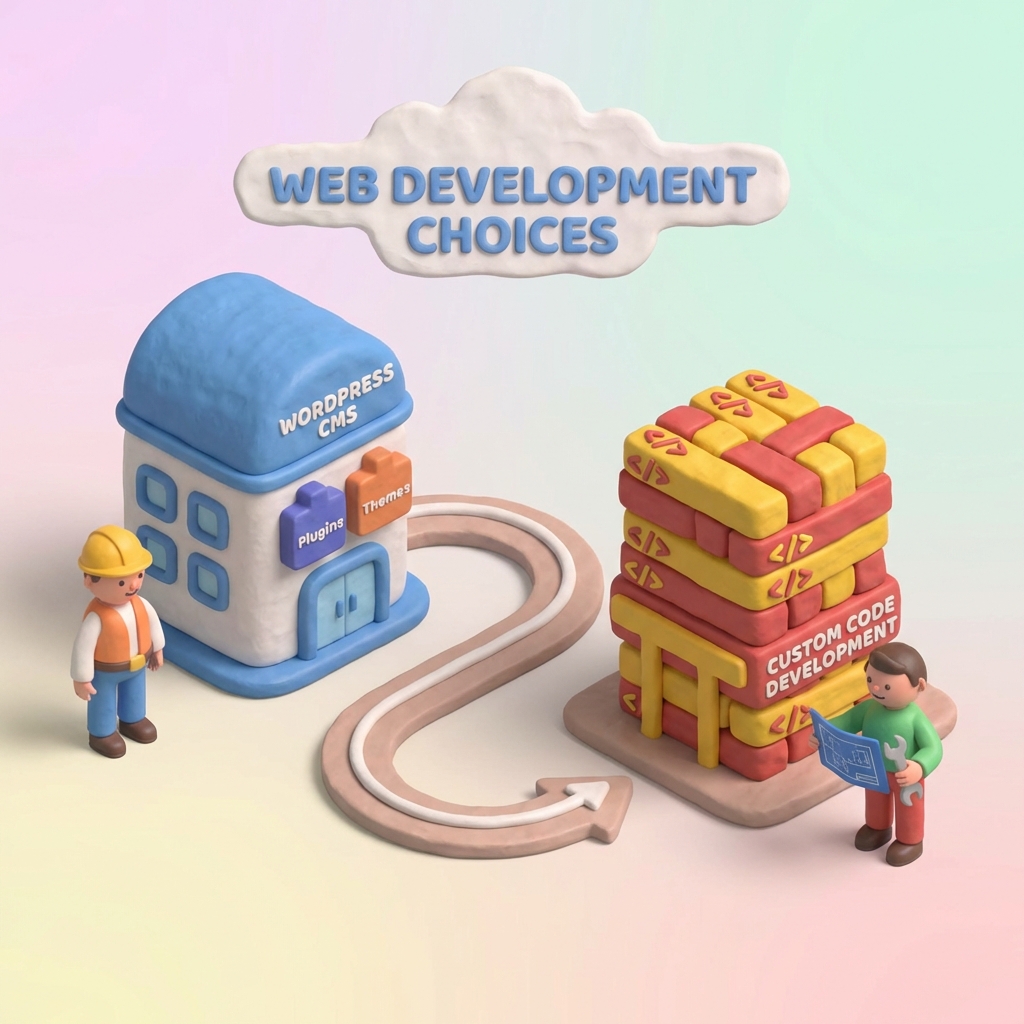
In essence, a CMS like WordPress provides a graphical interface (an admin panel) that allows users to create, manage and modify the content of a website without the need to interact directly with the code. Think of it as a pre-built and very robust scaffolding on which you can build your website, customizing it through themes and plugins.
Pure Code: The Art of Building from the Ground Up
When we talk about «raw code», we mean building a web site from the ground up using programming languages and web layout. The fundamental pillars of this approach are:
- HTML (HyperText Markup Language): Defines the structure and skeleton of the web.
- CSS (Cascading Style Sheets): It is in charge of appearance, visual design and styling.
- JavaScript: It provides interactivity, animations and dynamic functionality.
To this you can add server-side languages such as PHP (the same on which WordPress is based), Python or Node.js for more complex functionalities and database management. Developing with pure code is like being the architect and builder of your own house: you decide every brick, every beam and every finish.
The Big Question: Absolute Control (Code) or Autonomous Management (WordPress)?
At the heart of the decision between WordPress and pure code lies a fundamental balance. As one digital communication agency, The choice depends on the final objective. If your priority is to have a «greater control over appearance and functionality» to adapt a site to «exact needs», pure code is the way to go. It gives you unlimited power to create unique and highly optimized digital experiences.
On the other hand, if what you are looking for is a solution that allows the «editing and administration of the website autonomously».», Without relying on a programmer for every change of text or image, WordPress is the undisputed choice. Its administration panel, available in more than 40 languages, democratizes content management.
Good practice: Define your priorities before choosing: do you need a functionality that does not exist on the market or a standard website (corporate, blog, portfolio) that your team can easily update? The answer to this question will bring you closer to the right choice.
Pros and Cons: The Battle «WordPress or Pure Code».»
Let's take a point-by-point look at the pros and cons of each approach to get a complete picture.
Advantages of WordPress
- Speed of Development and Initial Cost: Creating a functional website with WordPress is significantly faster than programming it from scratch. This usually translates into a lower initial development cost.
- Ease of Use for the Client: Its intuitive control panel allows non-technical people to update content, publish blog articles or add new pages, offering great autonomy.
- Giant Extensibility Ecosystem: This is one of its greatest strengths. With thousands of themes (designs) and plugins (functionalities), you can add almost any feature you can imagine. A clear example is the plugin WooCommerce, which transforms a WordPress site into a powerful online store.
- Great Community and Support: Because it is so popular, there is a huge global community ready to help. You will find tutorials, forums and documentation for almost any problem or question.
- Accessible SEO Optimization: Plugins like Yoast SEO or Rank Math guide users to optimize the on-page SEO of their content in a simple way, even without being an expert in the field.
Disadvantages of WordPress
- Potentially Lower Yield: A WordPress site with a poorly coded theme or overloaded with plugins can become slow and cumbersome. Performance optimization (WPO) is crucial.
- Security Vulnerabilities: Its popularity makes it a prime target for hackers. If not kept up to date (core, themes and plugins), it can be vulnerable to massive attacks.
- Limited Customization: Although themes and plugins offer a lot of flexibility, sometimes you will hit a «wall». Implementing a very specific functionality that doesn't exist can be more complex and costly than creating it from scratch.
- Constant maintenance: It requires periodic attention. Updates are frequent and necessary for security and proper functioning, and can sometimes cause conflicts between plugins.
Attention! A WordPress site is not «install and forget». Ignoring security updates is one of the main causes of hacked websites. Maintenance is an active and necessary task.
Advantages of Pure Code
- Superior Performance: A custom programmed site contains only the code necessary to function. This results in ultra-fast load times and a smooth user experience, key factors for SEO and conversion.
- Security through Obscurity: Because it is not based on a massive platform, it is not vulnerable to automated attacks looking for flaws in popular WordPress plugins or themes. Security is tailored to the project.
- Total Control and Personalization: There are no limits. Any design, animation or functionality you can imagine can be built. It is the perfect solution for complex web applications or innovative platforms.
- Scalability with no strings attached: The architecture can be designed from the ground up to support high traffic volume or complex functionality in the future, without relying on a third-party structure.
Disadvantages of Pure Code
- Increased Development Time and Cost: Building from scratch is an artisanal process that requires many more hours of work by skilled developers, which raises the initial budget considerably.
- Complexity in Content Management: Unless a custom CMS is developed (which further increases the cost), any content change, no matter how small, will require the intervention of a programmer.
- Developer Dependency: The project is intrinsically linked to the developers who created it or to professionals with the technical skills necessary to understand and modify the code.
- High Learning Curve: Requires a team with solid knowledge in multiple web technologies.
Critical Note: The biggest hurdle of pure code for many companies is post-launch management. If your marketing team needs to publish news on a daily basis, relying on a programmer to do so is inefficient and costly.
Real Perspectives: What are the Developers saying?
Theory is all well and good, but this debate comes alive in the experiences of the development community. Doubts arise at both ends of the knowledge spectrum.
The Beginner's Dilemma: «I want to make money fast».»
This is a very common question among those who are new to programming. A programming student on a Reddit forum I was asking precisely this: if your goal is to «make a little money making websites» and you perceive that «WordPress makes it faster», why spend so much time learning to code from scratch?
This perspective highlights the appeal of WordPress for fast, monetizable results. However, the community response is often unanimous: learning pure code makes you a problem solver, not just a tool implementer. It gives you the ability to fix, customize and optimize WordPress at a higher level, or to tackle projects that WordPress simply can't handle.
The Expert's Doubt: «Why use a CMS if I already know how to program?»
Interestingly, doubt also arises in the opposite direction. A developer with knowledge of PHP, HTML, CSS and JavaScript asked on Reddit what are the real benefits of using WordPress instead of building everything from scratch.
The answer is efficiency. For standard projects - a blog, a corporate website, an eCommerce store with common functionality - reinventing the wheel by programming a user system, a content management panel and a text editor is a waste of time and resources. WordPress already offers all of that in a robust and proven way, allowing the expert developer to focus on advanced customization and unique project features, rather than on basic infrastructure.
So, which one to choose? Quick Guide according to your Project
To simplify the decision, here is a guide based on common scenarios:
Choose WordPress if...
- You need a blog, a corporate website, a portfolio or a news website.
- You want to launch a small or medium sized online store (WooCommerce is your ally).
- Your budget and/or launch time are limited.
- You need you or your team (non-technical) to be able to manage the content easily.
- The functionalities you require are standard and can be covered by existing plugins.
Choose Pure Code if...
- You are creating a complex web application (SaaS, social platform, online tool).
- Your project has completely unique design or functionality requirements.
- Performance and speed are the absolute top priority (e.g., a high-frequency financial tool).
- Security is extremely critical and requires a tailored architecture.
- You have a budget and a development schedule that allows for a build from scratch.
- Content is mostly static or changes will be made by a technical team.
Conclusion: There is no Winner, only the Right Tool.
As we have seen, the battle WordPress or pure code has no universal winner. Both options are powerful tools in different contexts. Dismissing WordPress as «less professional» is as big a mistake as trying to force it for a project that clearly demands a custom solution.
The smart choice is based on an honest analysis of your project's goals, resources and long-term needs. WordPress offers you speed, autonomy and a huge ecosystem in exchange for certain limitations in customization and a constant maintenance requirement. Pure code gives you unparalleled freedom, performance and security, in exchange for greater cost, time and technical complexity.
The next time you are faced with this decision, go back to this guide and ask yourself: Which tool will get me to my goal in the most efficient and sustainable way? The right answer will be there.
Do you need help with this?
We design websites that are built to turn visitors into customers—not just to look good. Discover our strategic web design service.


